






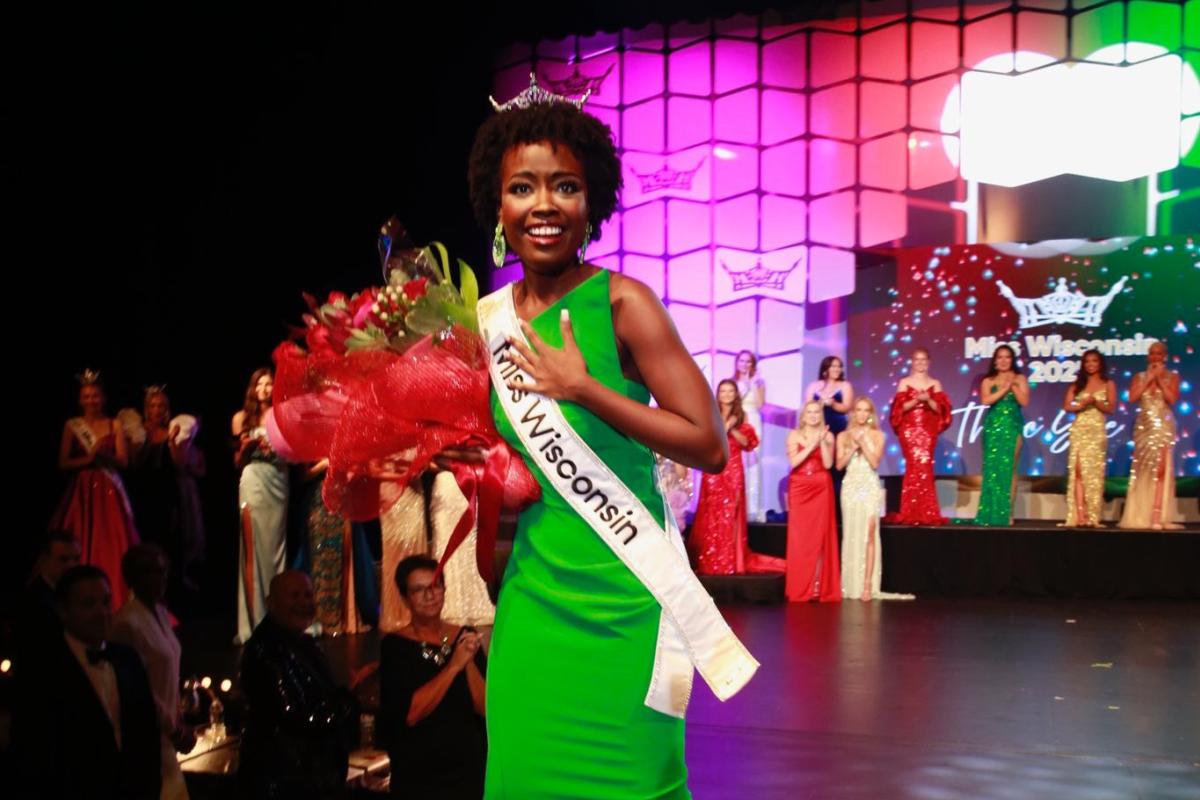
Willow Newell made history this year. She was the first Black woman to earn the crown as Miss Wisconsin, bringing her lifelong passion for performance and community storytelling into the spotlight. A Racine native and Carthage College graduate with a degree in musical theater, Willow has spent years in Wisconsin’s arts landscape, from singing on competition stages to performing lead roles in collegiate and community productions. Now, as Miss Wisconsin 2025, she’s traveling the state to promote her Community Service Initiative, The ART of Belonging, which emphasizes how creativity, confidence and connection grow when people have access to the arts.
Your initiative, The ART of Belonging, is rooted in the idea that art helps people feel seen and connected. How do you see theater and the performing arts creating that sense of belonging in communities, here in Milwaukee?
When I think about the performing arts scene in Milwaukee, I can’t help but immediately think of theaters like the Milwaukee Rep, the Pabst Theater and the Marcus Performing Arts Center, in which people don’t have to travel far to see internationally renowned works come to life.
As Miss Wisconsin, it brings me joy to highlight that Milwaukee has such a rich diversity of cultures, neighborhoods and experiences that harbor theaters and studios, both large and small. These performing arts spaces become a place where the unseen becomes seen.
I loved touring Milwaukee this September for Arts and Education Week with Vivienne Timchenko from the Wisconsin Arts Board. One of my favorite examples of a small community space that nurtures a sense of belonging through the arts is Bembe Drum and Dance Studio. Their year-round dance classes offer a sense of pride and education in various Afro-Latino musical traditions. They create a safe space for families to gather after school, to eat together and commune. Students are not only taught various rhythms and trained to perform, but are also given the opportunity to feel a sense of cultural pride.
You’ve spoken about how seeing Les Misérables as a child changed your life. What do you think it is about live theater that makes it so powerful and memorable?
The immediacy of live theater makes it such a vulnerable and powerful experience. There’s something extraordinary about a room full of people who all chose to take time out of their day to witness the same story, at the same moment, for the very first time. The lights, the music, the raw emotion that grand storytelling creates moments where you can feel the tension in the air.
When the Marcus Center invited me to see Les Misérables this October, there were moments where it felt like the entire audience was holding their breath together. I was instantly transported back to how I felt seeing the show as a child with the same sense of awe, connection and possibility. That experience is what inspired me to dedicate my life to storytelling across multiple mediums and to create opportunities for others to tell their stories as well.
You’ve described the arts as essential for developing creativity, confidence and collaboration. Beyond those, what other skills or benefits have you seen the arts nurture in the students and communities you’ve worked with?
I have presented my Directing Workshops in schools across the state, in which I use the Stanislavski method acting principles to encourage students to practice communication and self-discovery among their peers. What I have seen is that they grow empathy for each other.
When you play a character, tell a story or engage with another's perspective, you learn to feel for others. They are taught resilience when they are working together to create their scripts, and instead of succumbing to roadblocks, they learn to work together. Students of all learning abilities build leadership and initiative as they interact with each other. They are encouraged to help their peers.
How do you approach making the arts accessible to people who might not initially see themselves as “artistic”?
My Community Service Initiative Series can be found on social media where I interview various professionals in Wisconsin who have careers outside of the arts but were once inspired by arts influence.
I have had the honor of talking to David Lee from Milwaukee's NPR about how his experience in arts schools has given him creativity and problem-solving skills. Health Insurance worker Bennie Waldlington spoke on how growing up in the performing arts gave him the ability to connect with people from diverse cultures, and Racine Police Officer Gabbi Hood uses the team-building skills she earned from participating in band in high school as an officer now.
Representation matters deeply in the arts. As the first Black Miss Wisconsin and a lifelong performer, how do you hope your work helps make theater spaces more inclusive and reflective of the communities they serve?
While working with the Wisconsin Arts Board and promoting various arts spaces, I hope that sharing my personal story inspires anyone who has felt they have no place in theater to grow confident in the value they can bring to arts spaces. Growing up, I didn't always feel seen; my natural hair, voice and history didn't always match those around me or what I assumed would be required of me.
Through the Miss Wisconsin Organization, I eventually learned to embrace my unique journey. With this platform, I have the opportunity to be a voice for theater and performance arts. My mission is to let others know they belong here as well, regardless of race, background, physical ability, socioeconomic status or sexuality. Everyone deserves to feel empowered to perform.
What do you think musical theater can teach us about empathy and community that everyday life sometimes can’t?
Musical theater often puts us in the shoes of characters who are different from us. They live in different eras, have different backgrounds, have different struggles, yet they have similar longings, hopes and fears. That distance gives us perspective. It allows us to feel what it might be like. And when the ensemble on stage shows a community working together, voices weaving and characters supporting one another, it models a sense of “we’re in this together.”
In everyday life, we might be isolated, disconnected; theater offers a mirror and a vision of connectedness. In our communities, we need more empathy: listening, understanding, embracing one another. Musical theater teaches that our stories matter, that we can find connection through art, through performance, through collective experience. It reminds us that while we may be individuals, we are stronger together.
How can people learn more about The ART of Belonging and the work you’re doing to make the arts more inclusive across Wisconsin?
People can follow my journey via the Miss Wisconsin @missamericawi social media pages, where I’m sharing events, interviews and community stories. Also, through my personal social media platforms @willowiswillow on Instagram, Facebook and TikTok. I’m featuring artists across Wisconsin, sharing how the arts have impacted lives, and posting calls to action for workshops or community arts events.
If you’re part of a school, library, community center or arts organization and you’re interested in collaborating or hosting a workshop tied to The ART of Belonging, I can be booked on the Miss Wisconsin website. I’m committed to traveling the state, listening to people’s stories, celebrating their art and helping connect resources.
Finally, if you could capture your mission in one lyric or line from a musical, what would it be and why?
“Wicked” is one of my favorite Musicals of all time. One of my favorite songs, sung by Glinda and Elphaba, is titled “For Good.” Glinda opens the song with, “I’ve heard it said that people come into our lives for a reason, bringing something we must learn; and we are led to those who help us most to grow, if we let them, and we help them in return”.
There are so many people and experiences I have gained through the arts that have truly inspired me to keep going through difficult times in my life. I hope to also be that inspiration for others.
Feeling inspired? Learn more about Willow Newell and the Milwaukee Theater District.